Industry Perspectives
11 Minute
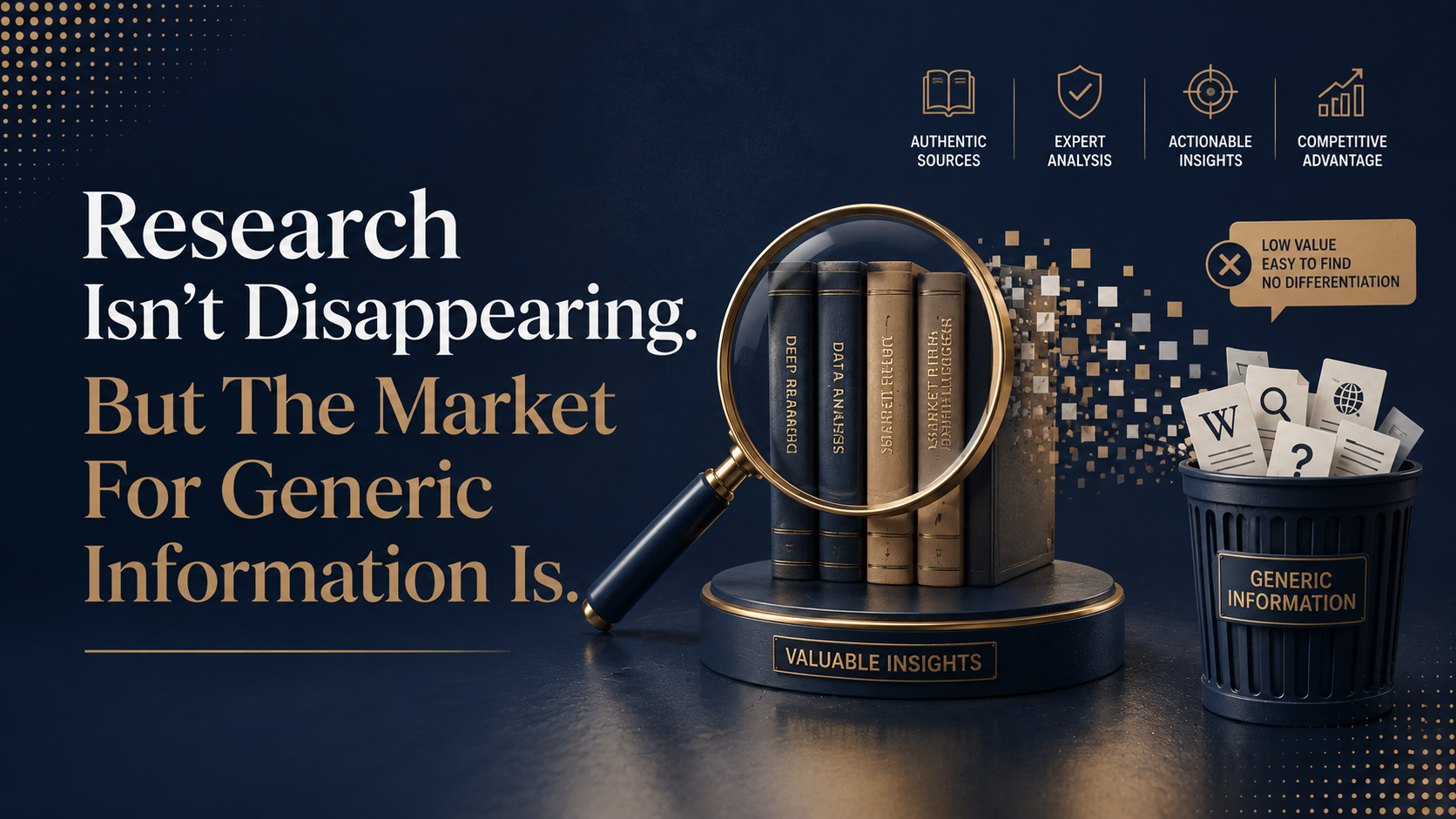
Research Isn’t Disappearing. But The Market For Generic Information Is.

Quite a bit has been written about how AI is going to disrupt the research industry. And to be fair, when we look around us, it already has. Access to information is no longer a challenge and many of the tasks that would have taken an analyst a few days can now be completed in minutes. Naturally, this raises a question. If information is available to everyone, what happens to research companies?
We have heard similar arguments before. I remember speaking to executives from the German trade fair industry during the dotcom boom in the early 2000s. At that time there was a genuine concern that exhibitions and trade fairs would eventually become irrelevant. The logic was simple. If buyers and sellers could connect online, if information was available at the click of a button, then why would people continue to spend money travelling to events and exhibitions?
Twenty-five years later, the industry is still thriving. In fact, in many markets it is larger than it was before. The reason is because people were never just paying for information. They were paying for access. They were paying to meet potential customers, partners, suppliers and industry peers. The internet made information easier to access, but it didn’t replace the need for human interaction. If anything, it made trusted interactions even more valuable.
I think something similar will happen with research. For years, research companies built successful businesses around collecting information, analysing it and presenting it back to clients. There will always be a place for that. However, the challenge today is that information itself is becoming easier to access. Most business leaders are not struggling because they cannot find data. They are struggling because there is too much of it. What they really want to understand is what matters, what is changing in their market and what impact those changes are likely to have on their business.
That is where I believe the role of research will evolve. Clients will continue to pay for intelligence, but they may become less willing to pay for information that is available everywhere. The value will increasingly come from interpretation, context and judgement. In many ways, this is already happening. Firms like Gartner and Forrester have expanded well beyond reports. They have built advisory businesses, executive communities, peer networks and events around their research. The report remains important, but it is now only one part of a much larger offering.
The same trend can be seen in media. Companies such as Morning Brew and The Information have invested heavily in memberships, events and communities. They understand that while information can be distributed at scale, access remains limited. Access to the right people, the right conversations and the right opportunities continues to have significant value.
This is why I believe communities will become increasingly important for research businesses. A trusted network of founders, CXOs, investors and industry leaders can provide perspectives that are difficult to capture through publicly available information alone. As a result, the distinction between research companies, media businesses and professional communities may become less clear over time.
Research is not disappearing and I don’t believe demand for good intelligence is going away either. What may disappear is the market for generic information that looks and sounds the same everywhere. The firms that continue to succeed will be the ones that can help businesses make sense of change, provide access to valuable networks and offer perspectives that cannot be easily replicated.
Tagged with :