Industry Perspectives
24 Minute
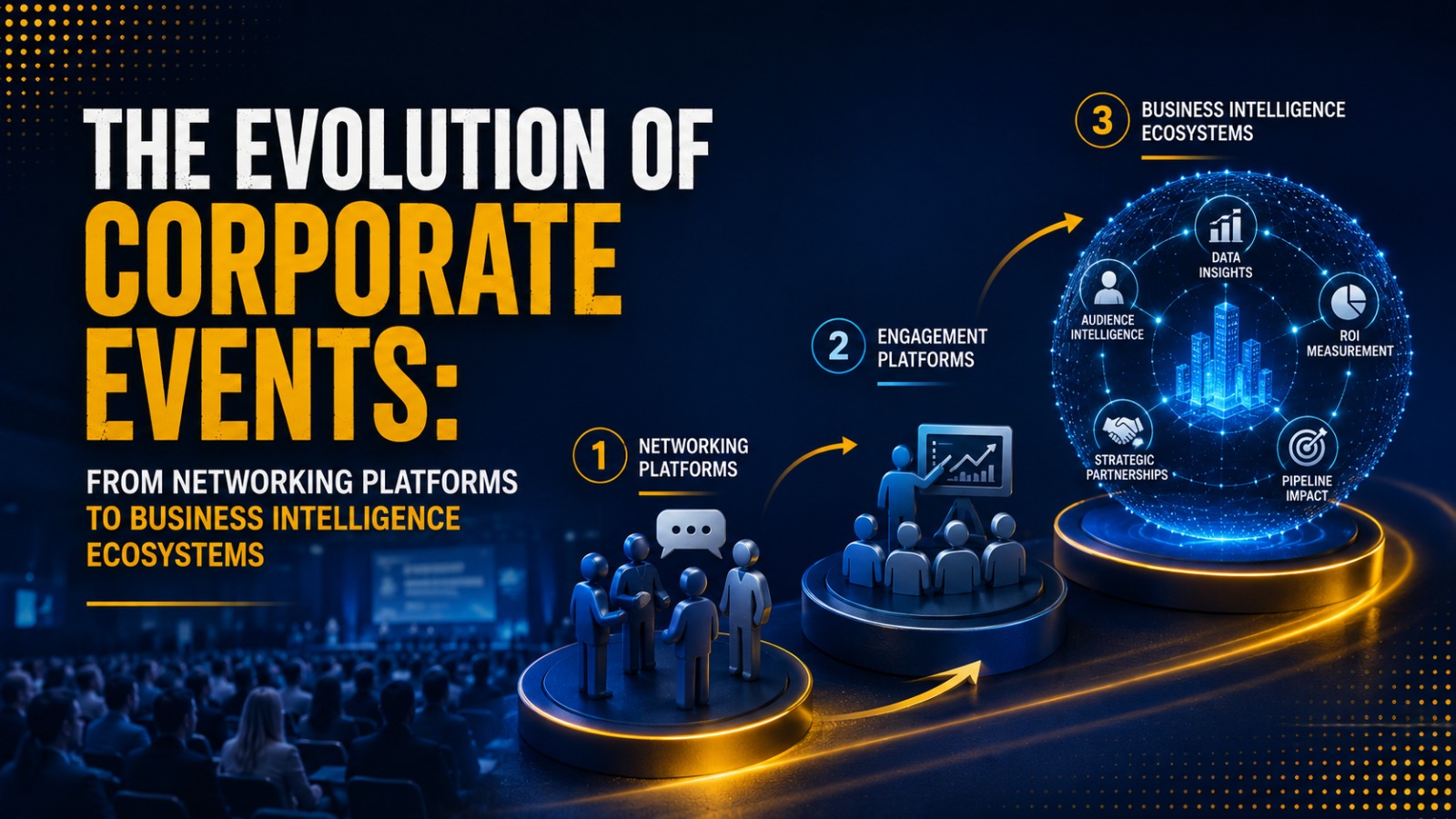
The Evolution of Corporate Events: From Networking Platforms to Business Intelligence Ecosystems

Imagine a hallway at a leadership summit. Two executives, holding coffee cups, are chatting during a break about a market challenge neither of their teams has been able to solve. After twenty minutes, they have drawn up the plan of a partnership that will be finalized in six months – no boardroom, no agenda.
Well-designed corporate events are the ultimate setting for that scene to unfold. It always has. What has really changed is everything around that conversation – the infrastructure, the data, the follow-up, the strategic intent behind why organizations send people to these gatherings in the first place.
And that shift is bigger than most people in the industry are willing to say out loud.
Corporate Events Are Not What They Used To Be
Let’s start with scale, because the numbers are genuinely striking.
The global corporate events industry recorded a market size of $330.9 billion in 2023. The market value is expected to double within 12 years and reach $730.7 billion in 2035 – a 7% CAGR that indicates planned and continuous investment rather than a post-pandemic recovery. A broader perspective shows that the global events sector is predicted to surpass $1.5 trillion by 2028, with an annual growth rate of 11.2%.
Clearly, these figures are not just the sign of a sector riding momentum. Companies are making deliberate decisions to increase their expenditures – and at the same time, they are raising their expectations of what they will get in return.
Which brings up the question that actually matters: what are they demanding?
For the longest time, it was content and contacts. A few insightful sessions, a few conversations, and some brand visibility. When the alternative was another cold email sequence, it worked reasonably well. But the baseline has shifted. At a data-driven event, the definition of value is changing, and organizations sticking to the old playbook are leaving significant intelligence on the table.
Why the Intelligence Layer Changes Everything
Here’s something that doesn’t get said enough about corporate events at the senior leadership level.
The Scaffolding of Value
In executive discussions, the official agenda is often just the skeleton. The real value comes from strategic proximity created through dinners, breakout sessions, and informal conversations between scheduled interactions.
Intelligent Infrastructure
What has evolved is the scaffolding itself. Modern events are built on intelligent systems that transform physical interactions into actionable business intelligence.
Precision Matchmaking
Technology is no longer simply supporting events. It is helping identify high-value conversations, relevant peers, and strategic opportunities before attendees even arrive.
Seamless Data Integration
AI and pre-event analytics can now surface potential partnerships, shared business priorities, and networking opportunities that traditional event planning could easily miss.
The Power of Pre-Planning
This influence is measurable. Studies show that 76% of attendee schedules are determined before the event begins, increasingly guided by data-driven recommendations and curated interactions.
Superior Conversions
Organizations using integrated CRM and event strategies often achieve conversion rates two to three times higher than those relying on traditional approaches.
The Premier Marketing Channel
Today, 80.4% of organizers consider events among their most effective marketing and business development channels.
Strategic Primacy
Despite unlimited access to digital channels, leading organizations continue to find that carefully designed, data-backed events outperform many alternative formats when it comes to generating meaningful business outcomes.
How Urban Lifestyle Affects How CXOs Think About Events Now
After 2022, the way senior leaders approached CXO networking changed significantly. Returning to physical interactions wasn’t merely a logistical shift – it was a strategic recalibration.
Executives who had spent years on back-to-back video calls returned with a renewed appreciation for what physical presence can reveal. The subtle read on a peer’s confidence. The non-verbal signals that communicate more than a presentation. The side conversation that begins with “off the record” and ends with a valuable piece of market intelligence.
These things cannot be replicated through a screen.
And leaders running large organizations understand this. That’s why as many as 67% of top executives increased spending on meetings and events for 2025, even as budgets in other areas faced pressure.
The investment wasn’t emotional. It was strategic.
This recalibration is evident across leadership forums and executive summits, where CXOs are engaging in fundamentally different ways. Rather than attending simply to be present, they arrive with specific questions about regulatory shifts, competitive movements, emerging partnerships, and market direction.
The event itself becomes a structured intelligence-gathering exercise.
More often than not, the difference between extracting value and missing it entirely comes down to preparation and intent.
The Three Things That Are Genuinely New
It’s easy to say corporate events have changed. The more interesting question is how.
Real-Time Sentiment Mapping
Real-time polls, engagement metrics, and audience interaction data now provide attendees with a live view of industry thinking. Not last quarter’s report. Not a forecast six months ahead. But what decision-makers in the room think right now.
That is a fundamentally different kind of insight.
Relationship Graphs
Modern event platforms do more than facilitate introductions. They document how professional relationships evolve over time.
Gradually, these networks reveal which organizations are collaborating, which conversations continue beyond the event, and where influence truly exists – often in ways that traditional organizational charts cannot capture.
For partnership development, ecosystem mapping, and competitive intelligence, this creates a powerful layer of visibility.
Content as a Living Asset
The keynote that once disappeared into an event archive now continues generating value long after the event ends.
Video clips, transcripts, engagement analytics, content consumption patterns, and discussion trends create a lasting data trail. A well-managed thought leadership event can continue producing insights and engagement for months after attendees have gone home.
What Business Leaders Should Actually Do With This
Simply attending more events is not the answer. Attending the right events with the right objectives is.
That means arriving with specific intelligence questions.
It means identifying, before registration, the conversations that matter most and the information you need to uncover.
It means planning follow-up before the event rather than after it.
And it means choosing platforms designed around strategic outcomes rather than simply logistics and programming.
For today’s executives, the real appeal is increasingly selection rather than scale.
Fewer events. More intentional interactions.
Spaces where the quality of conversation is curated as carefully as the speaker lineup. Environments built around insight, not simply attendance.
That hallway conversation – the one that eventually becomes a partnership and that no agenda could have predicted, still happens.
It simply happens more consistently when everything around it is designed with intention.
The Honest Problem: ROI Remains Difficult
To be fair, this evolution is not without its challenges.
More than two-thirds (71.2%) of event organizers report significant difficulty proving the ROI of live events to stakeholders. Only about one-third (36%) rely on structured measurement frameworks and data tools to evaluate outcomes.
Meanwhile, an astonishing 80% of trade show attendees receive no follow-up whatsoever – a statistic that continues to highlight one of the industry’s biggest inefficiencies.
The gap between the value executives instinctively recognize in corporate events and the measurable frameworks finance teams require is very real.
Bridging that gap requires treating events not as isolated moments but as part of a broader intelligence, relationship, and revenue ecosystem.
Every interaction – before, during, and after the event – needs to be connected to measurable business outcomes.
The organizations that successfully make this shift are transforming events into what they always had the potential to become: the most concentrated and productive information-gathering opportunities in their annual business operations.
Tagged with :